
Vertiginous
The complex pleasures of reading Martha Ronk

“Interpretation,” Martha Ronk writes in her 2019 collection, Silences, “means what obscurity always means / could stand for the ambiguity found / where no one could find you.” The “obscurity” in these lines repeats the opening line of the poem across the gutter from it, “Paris de Nuit”: “Obscurity without color, the night of Brassai means diffusion.” The sense repeated (with variations) on this verso and recto—of meaning potentially available but only in ways partial and/or proliferating—is one that I find often in the work of this accomplished poet.
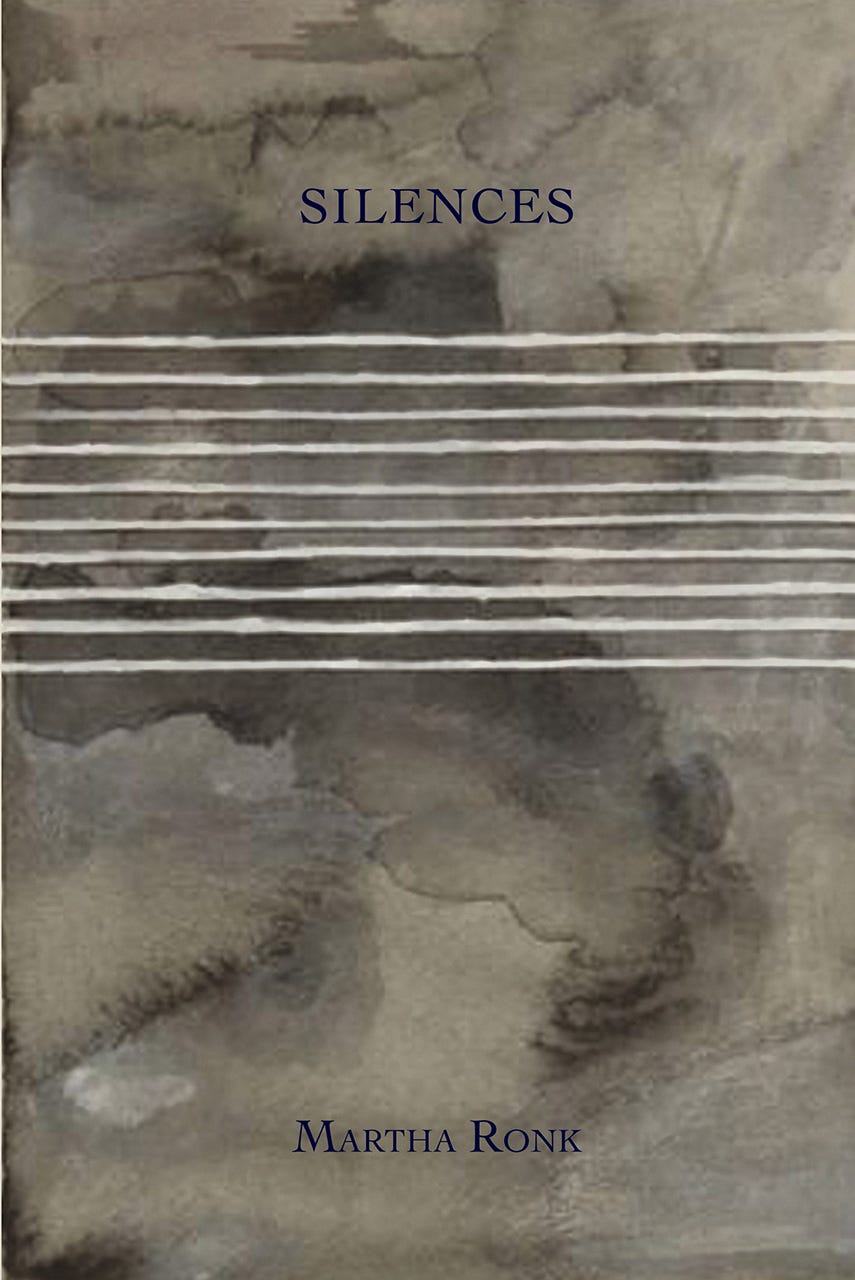
Silences was her twelfth book of poems (if my count is right), and the total has recently been increased with the publication of Clay (Omnidawn, 2025). I haven’t yet gotten hold of that book, but I have been a fan of Ronk’s poems for some time. Quietly experimental, pushing lyric and language to the limits of the expressible. Some of her interests and standard moves appear as early as In a Landscape of Having to Repeat (2004). The book’s title incorporates the title of one of John Cage’s signature works (“In a Landscape”), and the poems direct the consciousnesses of their characters through art and self-referring language (“He remembers looking at the photograph, / green and gray squares, undefined,” “If the illusion descends or the very word you’ve been looking for.” She often undertakes her explorations in dialogue with other art forms, especially the visual arts. There’s a lot about/on/engaging photography in Silences, for example, as well as poems on paintings by Magritte, De Chirico, and Van Gogh and a poem that riffs on T.J. Clark’s writing about Poussin’s Landscape with a Calm. As that last example suggests, even when Ronk is confronting the visual in her work, she stages the confrontation in and through the literary as well. She not only writes back to Clark’s assertion (quoted at the end of the poem) that “Language is always too specific and discriminating, it seems, when it tries to mimic the first idiotic appropriation of the visual,” but she also sidles into Magritte’s The Kiss via an epigraph from Beckett (“To restore silence is the role of objects”).
My favorites among her projects are those in which Ronk’s perceptions and meditations are explicitly and insistently refracted through the language of other writers. This has been a central practice of hers for much of her career as a poet. Shakespeare is all over her 2003 collection, Why / Why Not, even when Ronk’s focus is on paintings by Matisse, Renoir, and Van Gogh). Her 2012 book, Partially Kept, is in dialogue with the Renaissance essayist, Sir Thomas Browne, whose lines appear in italics but whose diction positively infects Ronk’s own in the spare and sparse poems, their phrases set with care amid more white space than appears in most of her volumes. And Vertigo (2007) takes many of its titles from (sometimes revised) sentences by W.G. Sebald. It’s this last book that I want to focus on for now.
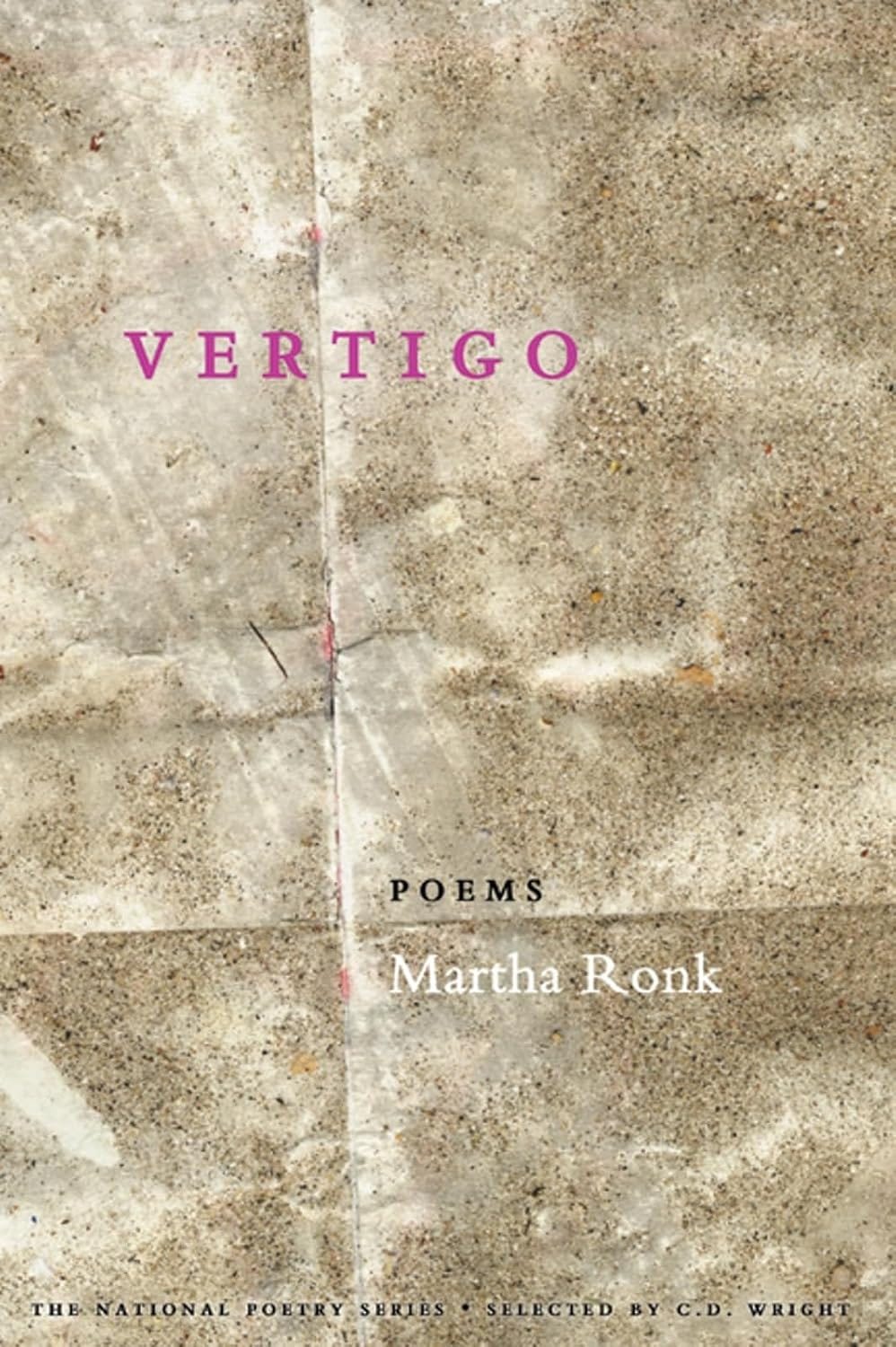
I choose Vertigo not because it was selected by C.D. Wright for the National Poetry Series (though that’s a good recommendation), but because, as someone who rereads at least one Sebald novel (usually Rings of Saturn, sometimes Austerlitz) every year, I am captivated by the volume’s play with Sebald’s voice and vision. If you have not read Sebald’s novels, you should. Indeed, you probably should read one of them (maybe Rings of Saturn) before you continue with this essay. But if you are not going to put this aside and read Sebald, then maybe it suffices for now for me to say that the books are characterized by a narrative voice whose lack of affect renders moments of emotional clarity more effective than they would otherwise be, by a syntax that tends toward the paratactic not only between but also within sentences. Both Sebald’s narrators and the subjects with whom they interact are often displaced, and the problem of displacement is often an explicit theme. In the poems that make up the first section of Ronk’s Vertigo, subtitled “I cannot remember anything about this journey other than this,” Ronk achieves a similar sense of flat reportage that indicates emotionally fraught underlying situations. We find ourselves alongside a speaker who refers from time to time to a “her” with whom the speaker is in a relationship that involves care and dependence. There are other pronouns: a “he” appears a couple of times, a “you” that might be the speaker addressing herself, a “we.” But the primary relationship is between the speaker and “her,” the latter of whom sleeps through the noise of crows, sometimes has bad days, sometimes acquires more definition. But rather than dramatizing this, or any, relationship, the poems meditate on perception, especially when perceptions or interpretations of them differ among the pronominal presences.
Let’s take a look at the title poem of this section. The poem consists of four sentences that fall into two pairs, the first pair taking up the first seven lines, the last two combining to make a six-line unit. The poem’s second sentence and its seventh line end together on a period, setting up something like a turn into the final six lines/two sentences; those two sentences get exactly three lines each, a period at the end of the poem’s tenth line neatly dividing them. If all of this sounds a little sonnetish, well, there you are. The septet (rather than a perfectly Petrarchan octave) establishes and develops both a situation and an idea about memory:
A moment of inattention brought it all back as in the dream
it catches in your throat and you jerk back from the edge or
hear the cry from someone else although the scene is eerily
quiet almost everywhere. The more images I gathered from the past
the more unlikely it seemed that the past had actually happened
in this way or that, but rather one had pulled back from the edge
and for that moment it all came rushing in.
Notice how this segment is framed by “moment” and the repeated reference to retreating (whether “jerk[ing] back” or “pull[ing] back”) from an edge. The first sentence emphasizes sound—the catch in the throat, the cry, the quiet—while the second emphasizes sight—images. The two senses are linked by “scene,” which provides a context for the first sentence’s sounds and a bridge to the second sentence’s “images.” We are caught off-guard in moments of lapsed attention, experiences imprinted and memories released as we recoil in surprise. What has preceded the moment doesn’t matter (“I don’t remember anything about this journey other than this”). The poem captures that sense of stumbling, the way we come to ourselves in a dark wood, and of the untrustworthiness of our accounts of those moments. Ronk reminds us that representation and memory are never of the event itself but, rather, of our previous representations and memories. Only in a “moment of inattention,” a slippage from our intentional gathering of images, is “it” brought back, does “it” come “rushing in.”
The situation set out here echoes the function of the Sebald sentence Ronk partially quotes. Late in his Vertigo, Sebald recounts a long day traveling by train in Germany, the long way back toward England from his native village, “W,” in Germany. He breaks a sentence with a parenthetical interruption: “I cannot remember anything about this journey other than the grotesque figure of a middleaged chap of gigantic proportions who was wearing a hideous, modishly styled Trachten suit and a broad tie with multi-coloured bird feathers sewn onto it, which were ruffled by the wind.” For Sebald, this vision stages a confrontation with an echt Deutsch exemplar from whom the speaker is escaping back to the life he has made in another country. A bit like Countee Cullen’s speaker in “Incident,” for whom the sights of Baltimore are overshadowed by a racial slur hurled at him by a child, Sebald’s narrator’s whole trip through Germany, into his past and the nation’s, is overshadowed by this revenant figure. In Ronk’s almost-sonnet, the line emphasizes the part emotion plays in what and how we remember: “Events that might have happened otherwise play themselves out / in ways that begin to seem familiar.” Pivoting mid-sentence to language itself, she figures the single word that alters the flow of perception and memory to a “jutting rock” that redirects a stream. This image leads to the concluding image, the stream finding its metonymy in “a man fishing.” Ronk solders perception (“I see”) or memory (“I see” in the implied mind’s eye) to writing via the closing lines’ simile: “the line spooled out / over his head in beautiful figure eights as if I were practicing / my hand in the school my mother went to before I was born.”
I’ve been hanging out with this opening sequence of Vertigo for a few weeks as I’ve been busy wrapping up the academic year, prepping and mounting a new summer program for high-school students, and watching soccer until my eyes dry up and threaten to fall from my head. I have thoughts about the dramatic situation in which these characters are set, but I don’t really mind if I’ve got it wrong. The intense pleasure that these poems offer is in their cleansing of perception through their performance of self-consciousness of perception, of renewing memory in their rehearsal of memory’s necessarily linguistic foundation and in the slippages that both consciousness and language build into the process. But it’s time to move on from these poems for now. My copy of Clay arrived this week, and I can’t wait to read it.