
Spring Break
And I'm Rereading Terrance Hayes's Spectacular Sonnet Sequence

It’s Spring Break, and I like to use this lull at the hinge of seasons, as things are beginning to return (entering a new world naked, as Williams reminds us) to reread something, and not something that I’m rereading because I’m teaching it (though that is my excuse for enjoying, again, always, Mrs. Dalloway). This spring, for all kinds of reasons, I’m taking yet another look at Terrance Hayes’s American Sonnets for My Past and Future Assassin.
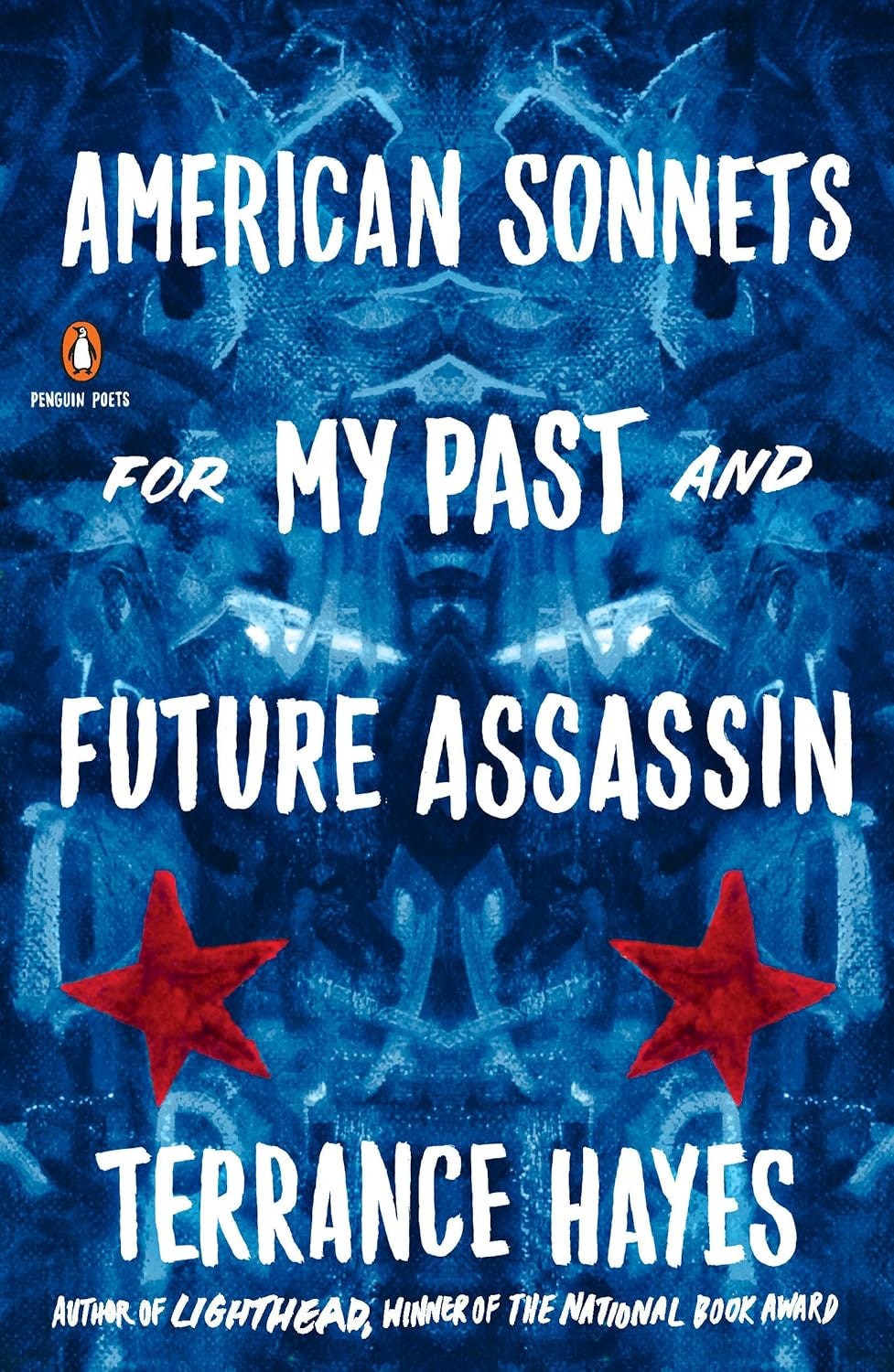
The Black sonneteer would love to say his tradition began with Hughes or God forbid Hayden, but actually it began at the intersection of Renaissance artifice and enforced deportation, of enjambment and enslavement, the fashioning of constraints both martial and musical, violent and visionary, stern and stanzaic. The Black sonneteer frets not in the form’s narrow room, seeing its demands to repeat—sounds, words, phrases, sometimes the refrain that kicks the turn at the ninth line and raises it to fourteen identical instances of figurative transformation: “We sliced the watermelon into smiles.” Or to seventy identically entitled American Sonnets for My Past and Future Assassin.
Nobody would reduce the rich and varied career of Terrance Hayes to the phrase “Black sonneteer,” but that is one role that Hayes has played since the publication of his Whiting Award-winning first book, Muscular Music. Over the last twenty years and more, he has published six poetry collections, including Hip Logic, which was a National Poetry Series selection, Wind in a Box, which was named by Publishers Weekly as one of the best books of 2006, Lighthead, which won the 2010 National Book Award, and How To Be Drawn, which won the NAACP Image Award for Poetry in 2016. American Sonnets for My Past and Future Assassin, the amazing book that came out in 2018, was a finalist for the National Book Award, the National Book Critics Circle Award, the T.S. Eliot Prize, and just about every other prize a poetry volume can win. Since that book, Hayes has published two more collections as well as a book of criticism. Oh, and I forgot to mention that Hayes was named a MacArthur Fellow in 2014.
Okay, I can list the prizes and honors and that’s great, but it doesn’t give a sense either of why Hayes is so powerful a poet on the intricacies and injuries of race in America or of how he is such a pleasure to read. Here, I’m going to try just to suggest these two intertwined elements of Hayes’s poetry, mostly in the book that keeps me coming back year after year.
A favorite poem of mine since I first came across it when Hip Logic was published is “Touch.” “We made our own laws,” that poem begins, capturing both the order and the outsider nature of touch football. “By moonlight / we chased each other / around the big field / beneath branches sagging / as if their leaves were full of blood.” The poem narrates the violence of this play, the way it is, at some level, a brawl, but also the way the playfulness of the brawl within the lines of a field is misread (willfully misread) by the police who are poised to see only the violence and not the playfulness, to tackle in a category error the players as if they are, because they are, always and already in the cops’ eyes, criminals. “It’s true,” Hayes writes, “we could have been mistaken / For animals in the dark, / But of all our possible crimes, // Blackness was the first.”
I’d never have thought of touch football (even as someone who has been a dedicated player for decades) as a figure for poetry, but in it we can see the definition of poetry Hayes offers in “Lighthead’s Guide to the Galaxy”: “an arrangement of derangements.” There are rules that enable performance, constraints that provoke brilliant invention and improvisation, and within the space of this rule-bound play there are opportunities to take on the violence that lurks just beyond the sideline. There are the ways the human can don other identities and play them out, and there are the vulnerabilities of misidentification that this disguising can elicit. On the field of the poem’s page, Hayes takes up with rigor and energy everything from the rules of the game to the policing of the boundaries. His intellect is unfailingly critical, and in his testing of the value of his predecessors’ work he is as probing and questioning of Robert Hayden (“Is this why / you were quiet when other poets sang / of the black man’s beauty?”) as he is of Wallace Stevens (“This is a song for my foe, / the clean-shaven, gray-suited, gray patron / of Hartford, the emperor of whiteness / blue as a body made of snow”). And in the breathtaking and brilliant and bruising American Sonnets for My Past and Future Assassin, Hayes wields the traditions of the sonnet and the sonnet sequence against everything in American history and culture that has been trying to kill him.
In the longer essay I hope to write on that book, I’d want to spend pages discussing the ways he plays variations on the themes of race and violence in these poems, the ways he turns the conventions of the sonnet against the form to perform what Houston Baker describes as the essence of African American literary production, the “deformation of mastery.” For now, I’ll stick with just a couple of examples. When you read this sequence straight through, which you should, you’ll notice the recurrence throughout it of “money.” Sometimes the word is spelled lowercase, and the significance that comes to the surface has to do with exchange value and commodity logic and wealth (or its absence, or its unequal distribution, or the racialized impediments to its accumulation). And sometimes the word is capitalized, bringing to the fore its significance as the name of a town in Mississippi, the location of an infamous atrocity, the murder of Emmett Till, a metonym for the acts of assassination America routinely and insistently perpetrates on its Black citizens. This repetition of reference, incrementally accruing new meanings in new contexts, a thread rising to visibility, disappearing momentarily, and rising again to change our sense of what surrounds it, is at once part of what Hayes inherits from the sonnet sequences of Sidney, Spenser, and Shakespeare, and part of the machinery with which he sets out to lock his American assassin “in an American sonnet that is part prison, / Part panic closet, a little room in a house set aflame.” By the way, you hear echoes of Wordsworth and Donne in that little line and a half, and Hayes adds to this allusive wit the wordplay a few lines later of “I make you both gym & crow here. As the crow / You undergo a beautiful catharsis trapped one night / In the shadows of the gym.”
These poems, with their blood and breaking, their sleeper holds and caution tape and bombs and bodies, can be hard to read, or they would be but for the last note I’ll strike here, which is the note of hope and joy that also sounds and resounds throughout this book. I hasten to say that the hope and joy do not reside in the poems’ images or narratives or themes. But poems, those arrangements of derangement, are not only matters of sense. They are made up, too, of sound. They are songs, and in the music of what happens in them, as in the long tradition of the blues, or before them the sorrow songs DuBois describes, or before those the deeply pained singing Douglass condemns white folks for misunderstanding, misery and despair, anger and anguish, are transformed. Hayes is a consummate musician in these poems, as he has been throughout his career. Even as he forces our attention on “Florida, Ferguson, Brooklyn, Charleston, Cleveland, Chicago, Baltimore, wherever the names alive are / Like the names in graves,” even as he castigates a culture that pays Black poets to name Emmett Till, he gives us “The umpteenth thump on the rump of a badunkadunk / Stumps us. The lunk, the chump, the hunk of plunder. / The umpteenth horny, honky stump speech pumps / A funky rumble over air.” Taking Harryette Mullen’s virtuosity to Michael Harper’s death-watching scrutiny, Terrance Hayes liberates in and through and from these American sonnets. This vital virtuosity has made the book one of those to which I return every year. If you haven’t read it in a while, maybe it’s time.